
Dietitian Blog, Research/Industry Updates | Jul 10 2026
2025-2030 Dietary Guidelines for Americans: A dietitian’s review
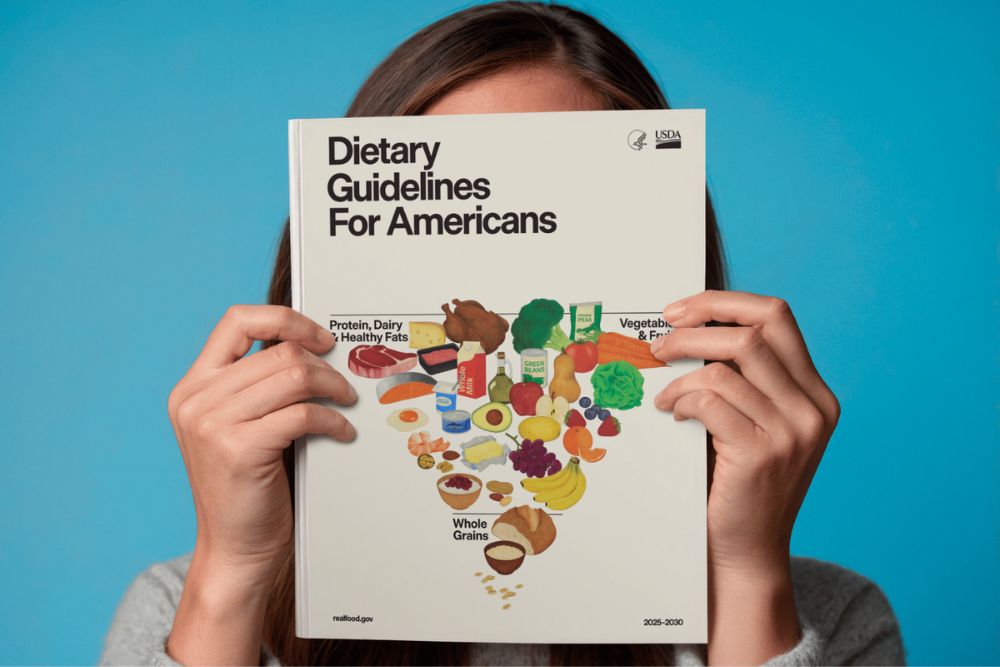
The new 2025 to 2030 Dietary Guidelines for Americans (DGA) are old news by this point. Now that the dust has settled and maybe the shock factor has worn off, it’s time to go line by line and examine the facts of these guidelines.
At first glance, the 2025 to 2030 DGA and the 2020 to 2025 DGA appear strikingly different. There is brand new imagery, bold and concise statements, different messaging, different formats, and different audiences. But looking at the supporting documents and upon further review, the guidelines may share more similarities than they initially appear to.
How do the new Dietary Guidelines for Americans compare?
The dietary guidelines have statements that can be grouped into three general categories: the same or similar to the previous dietary guidelines, not a new recommendation but new to the dietary guidelines, and a relatively new statement in the DGA. The target audience for the 2025 to 2030 DGA appears to be the public directly, instead of healthcare professionals or people who use the dietary guidelines to make nutrition recommendations to others. They are significantly shorter (10 pages, compared to 164 pages), have a lot less text, and list fewer additional references outside of the scientific foundation.
The Scientific Foundation For The Dietary Guidelines For Americans was created as its own framework and basis for the new DGA, rather than using the Scientific Report of the 2025 Dietary Guidelines Advisory Committee (DGAC). This foundational document identified 56 recommendations from the DGAC and categorized them as implemented, partially implemented, and not implemented. 14 were implemented (25%), 12 were partially implemented (21%), and 30 were not implemented (54%).
Some of the statements may be oversimplified in the new guidelines, which can lead to some confusion. However, when correlating those statements to The Scientific Foundation For The Dietary Guidelines For Americans, the statements have more context. If the intended audience is the American public, who are unlikely to sift through the longer document, some of the messaging is confusing, incomplete, and can potentially lead to the opposite of its intended effect.
An example of a recommendation that may cause confusion is the guidance to consume 1.2 to 1.6 g per kilogram of protein, which contrasts with the Dietary Reference Intake (DRI) recommendation of 0.8 g per kilogram. Additionally, the acceptable macronutrient distribution range (AMDR) of 10 to 35% of total calories from protein has not changed.
Another example is the inverted pyramid promoting fat intake (particularly animal fats and full-fat dairy), but the recommendation of not exceeding 10% of total daily calories from saturated fat remains. These examples highlight the importance of registered dietitians as the nutrition experts in interpreting general guidelines and helping apply them to individualized nutrition therapy.
Important macronutrient recommendations to recognize
If looking at just the inverted pyramid and basing choices from the picture as far as the quantity of foods to eat in a day, one could easily find themself exceeding 10% of calories from saturated fat. Additionally, the recommendations for people to eat more animal fat and to consume full-fat dairy products assume that they are also going to follow the recommendation of “eating real food“ and avoiding highly processed foods that contain high amounts of saturated fat in order to maintain that 10% boundary.
If, however, people are not going to decrease their saturated fat from other sources, the added saturated fat from full-fat dairy and from animal proteins could be problematic and worsen chronic disease associated with high saturated fat intake instead of reducing it.
The inverted pyramid insinuates that grains are to be minimized in the diet. Many people mistakenly confuse grains with carbohydrates in general. And they may easily misinterpret this to promote a low-carb diet, when it is really just promoting a lower grain diet.
The recommendation to eliminate or reduce as much refined grain as possible assumes that a person is still going to be receiving enough carbohydrates in total because they will be consuming appropriate portions of starchy vegetables, legumes, fruits, and dairy. If a person doesn’t implement the recommendations supporting their carbohydrate intake from starchy vegetables, legumes, fruits, and dairy with their smaller portion of whole grains, they could be deficient in carbohydrates.
Another of the recommendations says to reduce alcohol. There is a wide body of evidence to support a specific number of drinks for both men and women that are deemed acceptable, and that higher quantities are deemed excessive and harmful to health. So, if a person is consuming an excessive amount of alcohol and they only “consume less,“ then have they really achieved the fullest health benefits? What the updated DGA gains in simplicity, direct communication, and clear messaging, it may lose in complete answers, appropriate parameters, and precision.
Implementation recommendations
As a whole, the updated DGA really could provide a well-balanced diet and fall within evidence-based nutrition recommendations. But if some messages are only adapted in part, there could be more harm than good. This is in direct contrast to the previous edition of the DGA. In the 2020-2025 DGA, each key recommendation could be implemented alone and still have some health benefits. Some of the recommendations from the 2025 to 2030 DGA depend upon the full implementation of the recommendations.
This round of DGA implemented some recommendations that may not be considered evidence-based by the broader body of the scientific community. Some of the recommendations are based on evidence that would be considered preliminary or emerging by some standards. In general, there are real limitations of nutrition research.
There’s a baseline of limitations due to the epidemiological nature of nutrition research, the difficulty in drawing clear correlations between diet intake and a person’s health, and the multifactorial elements involved in connecting somebody’s nutrition choices and their health outcomes. Understanding that nutrition research has some inevitable limitations, the United States Department of Agriculture (USDA) must be careful with the strength of each recommendation at a population level.
A dietitian’s perspective on the updated guidelines
As a private practice registered dietitian, I often use the DGA in my nutrition counseling for people who really don’t know the building blocks of a healthy diet and who benefit from a template mentality in thinking about types of food, food groups, and portion sizes on a daily basis. What I have liked about the previous guidelines is that if any piece of guidance is implemented, even in isolation, there is benefit to the client.
It does concern me to think about recommending full-fat dairy products to a client who has no intention of discontinuing their daily fast-food breakfast or recommending a reduction in alcohol without some parameters. Or recommending 1.6 g/kg of protein when protein supplements will be used instead of food to meet that target, or recommending 2-4 servings of whole grains when misinformation about carbohydrates abounds.
In summary
The previous guidelines allowed more for the addition of healthy foods with the hope of replacement or reduction of other foods, but the updated guidelines depend upon the reduction or exclusion of certain foods to make the guidelines fit within evidence-based parameters. Of all the comparisons to make between the two sets of guidelines, this is the one that stands out the most.
Also, the plate-based eating method has a notable amount of research backing it across multiple populations for its long-term benefit in changing eating habits. Will the USDA update MyPlate to reflect the new dietary guidelines? At this point the USDA website indicates that MyPlate is obsolete.
Most dietitians can get behind the idea of “eating real food,” but how to best help people achieve that when considering all that influences one’s dietary intake remains the challenge. Are nutrition guidelines that must be implemented in full to be beneficial really the best way to address chronic disease at the population level in the United States?
Population recommendations do not replace personalized medical nutrition therapy, but they should offer a beneficial starting point for the majority of their target population. Time and continued research will reveal the effectiveness of these guidelines in the coming years.
Dietitians On Demand is a nationwide staffing and recruiting company for registered dietitians, specializing in short-term, temporary, and permanent-hire positions in acute care, long-term care, and food service. We’re dedicated to dietitians and helping them enhance their practice and excel in the workplace. Check out our job openings, request your coverage, or visit our store today!
References:
The Scientific Foundation for the Dietary Guidelines for Americans. Realfood.gov website. Published 2026. Accessed March 16, 2026. https://cdn.realfood.gov/Scientific%20Report_508.pdf
Daily Servings by Calorie Level. Realfood.gov website. Published 2026. Accessed March 16, 2026. https://cdn.realfood.gov/Daily%20Serving%20Sizes.pdf
Dietary Guidelines for Americans 2025-2030. Realfood.gov website. Published January 7, 2026. Accessed March 16, 2026. https://cdn.realfood.gov/DGA.pdf
The Scientific Foundation for the Dietary Guidelines for Americans Appendices. Realfood.gov website. Published 2026. Accessed March 16, 2026. https://cdn.realfood.gov/Scientific%20Report%20Appendices_FINAL_1.28.26.pdf
Dietary Guidelines for Americans 2020-2025. Dietaryguidelines.gov website. Published December 29, 2020. Accessed March 16, 2026. https://www.dietaryguidelines.gov/sites/default/files/2020-12/Dietary_Guidelines_for_Americans_2020-2025.pdf
Dietary Guidelines Advisory Committee. Scientific Report of the 2020 Dietary Guidelines Advisory Committee: Advisory Report to the Secretary of Agriculture and the Secretary of Health and Human Services. Dietaryguidelines.gov website. Published 2020. Accessed March 16, 2026. https://doi.org/10.52570/DGAC2020

About Courtney Lee
Courtney Lee, MS, RDN, CDN, CLT, CFCS is a subject matter expert with Dietitians On Demand and has a virtual private practice. Courtney enjoys equipping dietitians and dietetic interns with the tools they need for professional success, so they don’t have to learn the hard way.
Who we are
Dietitians On Demand is the nationwide leader in providing dietitians with jobs they love. If flexibility, competitive pay, a full benefits package, free CPEUs each month and a team dedicated to dietitians sound good to you, apply to our positions today.


